
 by Amanda Dingus
December 16, 2025
by Amanda Dingus
December 16, 2025
Every customer conversation starts as sound – not text.
Before any AI model can detect intent, analyze sentiment, or generate summaries, it must first understand the audio itself.
That foundation comes from Acoustic Models.
They are the core technology that helps transcription engines interpret speech across accents, noise levels, languages, and environments.
In modern contact centers, Acoustic Models determine whether your downstram intelligence is accurate – or unreliable. Below, we break down what Acoustic Models are, how they work, and why they matter for enterprise-scale CX operations.
Acoustic Models are machine learning models that map the raw acoustic signals of speech – pitch, tone, frequency, energy, and timing – to the sounds and patterns of human language.
Think of them as the “ears” of a transcription system. They analyze how speech sounds before any words are recognized.
Acoustic Models work alongside language models, punctuation models, and metadata systems to produce accurate, readable transcripts.
In enterprise environments, conversations rarely happen in pristine studio conditions.
Real-world audio includes:
Acoustic Models are trained to recognize and adapt to these conditions.
When Acoustic Models perform well, enterprises see:
When Acoustic Models perform poorly, everything downstream suffers.
Behind the scenes, Acoustic Models use advanced signal processing and deep learning to interpret sound.
The process typically includes:
The model analyzes the waveform and extracts features like:
This creates a compact, machine-readable representation of the audio.
The model matches these features to known sound units, like phonemes and syllables.
Examples include:
Speech rarely exists in isolation. Acoustic Models examine patterns across time to understand how sounds flow into words.
Finally, the acoustic output interacts with language models to determine the most likely word sequence.
This layered process produces the transcription you see – and the insight your tools depend on.
To increase clarity, here’s how Acoustic Models compare to related concepts:
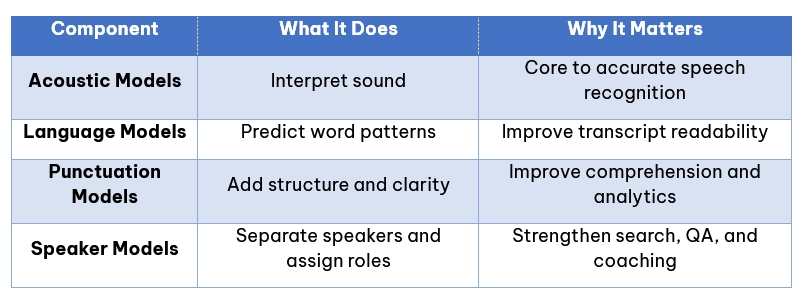
Chart: Decoding Models
Acoustic Models are the first step – and everything else depends on them.
Acoustic Models are essential anywhere voice data fuels decision making:
Contact Centers. Clean transcripts improve routing, coaching, QA, and compliance.
BPOs and Outsourcing Partners. Global accents and varied audio conditions require strong acoustic adaptation.
Real-Time Applications. Low-latency acoustic processing enables live dashboards, alerts, and agent assist.
AI Insights and Analytics. Reliable acoustic recognition improves sentiment, summarization, and classification.
Machine Learning and Model Training. Better input = better training data = stronger downstram AI performance.
In every case, Acoustic Modeling ensures your voice data is trustworthy.
At ElevateAI, Acoustic Models power both Post-Call and Real-Time Transcription across the CX and Echo transcription engines.
We deliver enterprise-level performance by designing models that:
Adapt Across Environments. Our models handle call centers, remote workspaces, mobile audio, and noisy conditions.
Support Diverse Speakers. Trained on varied accents, dialects, and vocal profiles – global and inclusive.
Maintain Low Latency. Designed for real-time use cases, with sub-second transcription.
Enhance Downstream AI. Better acoustic interpretation leads to:
Deliver Consistently Across Channels. VOice, VoIP, WebRTC, Mobile, and PSTN audio all benefit from consistent modeling.
This creates a transcription experience that is accurate, stable, and ready for enterprise scale.
Great intelligence comes from great inputs.
Acoustic Models transform real-world audio into accurate, structured text – unlocking insight at every stage of the CX journey.
With NiCE ElevateAI, your voice data becomes more than a transcript.
It becomes actionable, reliable intelligence.